Thursday, 14 May 2020

Top Cross-Platform Mobile Frameworks’ Comparison: React Native vs Xamarin vs Flutter

Mobile Phones, today, are kept at an arm’s distance.
Mobile Applications are already a fundamental part of our daily life.

As every day we all use mobile devices to make purchases, access our bank account, manage our social networks, etc. the two assertions made above, prove to be right certainly.
The development of mobile applications is an emerging business, as almost every passing day, we are connected to more people and more brands via a few clicks and taps on a mobile device.
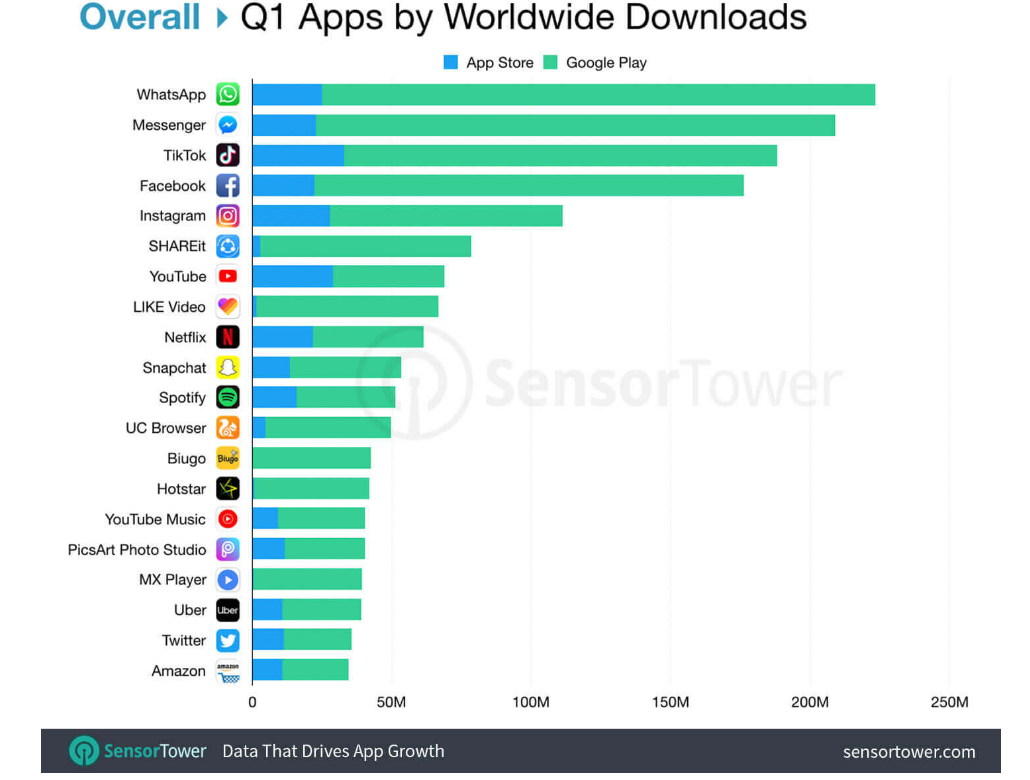
Looking at the graph below, one can make out how much significance an app carries in today’s mobile era. 
Why Cross-Platform App Development?

When the talk is about mobile app development, the stress is upon building robust mobile applications to enhance user experience and take it to the next level, simultaneously, bringing fruitful business gains to the company.
Aligning with our goal and taking a serious toll on app performance when we checkout platforms as the best fit, cross-platform app development seems to be on the top, favored by one and all (Businesses as well as Developers). 
  • Cross-platform app development has a much smoother learning curve than others in the line. 
  • This technology was born to reduce costs, time and facilitate the learning and development of mobile applications, also providing the possibility of creating websites with these developments. 
  • For this reason, we could say that these types of applications are totally multiplatform (Mobile, Tablet, Computer, TV,…) where, with the development of a unique code we can generate applications for the desired platforms. (In the case of mobile, for Android and iOS.)
  • The app development lifecycle span is reduced to almost half with the possibility of 96% code-sharing across distinct platforms.
  • Testing a single codebase or many smaller ones simplifies the testing process and offers high-quality test coverage.

XAMARIN VS REACT NATIVE VS FLUTTER: All in All Comparison

#Flutter
Reinventing the Native Mobile SDK
Framework Development Motive:
  • Show off technical skills and improve corporate brand
  • Streamline in-app development
  • External procurement of framework debug resources
  • Revitalization of the mobile application development industry
#Xamarin
Introducing C # to mobile application development
Framework Development Motive:
  • Corporate Brand Improvement
#React Native
Introducing web front end development method by React to mobile application development.
Framework Development Motive:
  • Show off technical skills and improve corporate brand
  • Streamline in-app development
  • External procurement of framework debug resources
Let’s see an explanation of the motive.
The significance of Xamarin to Xamarin was the direct revenue from selling the framework. Xamarin was acquired by Microsoft only after Xamarin was quite mature, thus, a notable reason for Xamarin to exist at the time of acquisition is to improve the corporate brand.
The immediate motivation for Facebook to start with React Native App Development was predictably to make the mobile experience go beyond what is delivered by HTML5. The purpose of releasing it on OSS is to improve the corporate brand by debugging React Native by the application developer community and showing off the technical capabilities.
[Zuckerberg doesn’t say what’s wrong with HTML5 for them. However, it implies that the quality of the developed product was insufficient. “A great mobile experience requires the highest quality and only native apps can achieve it.”]
The first motivation for Google to start the development of Flutter was to enhance the efficiency of in-house development. Material Design with a plain Android SDK is difficult. In fact, the implementation of Material Design on Android is more advanced in the Flutter version than in the Android SDK version. 
The motivation can also be seen from the early adoption of Flutter in the advertiser app of AdWords, which is the most external mobile app for Google’s business.
Having all that said about how these robust platforms took an industry advent, now we’ll dig deep into each spectrum targeting their architecture, programming languages, platform, and others.

Naturally, React Native adopts the Reactive pattern, which is popular in React.

Inventing the Reactive pattern and bringing it to mobile would be a credit to Facebook.
Flutter also respects React and uses the Reactive pattern.
However, instead of introducing the development method of the web front end, it is built from scratch as a native mobile application development framework.
Xamarin utilizes the MVVM pattern, (Model-View-ViewModel), maintaining a clean separation between app logic and UI aims to resolve many other development glitches to build an intuitive and productive mobile application.


Is the web backend, the biggest use case of C #? With Xamarin, backend developers can leverage the power of C# and can develop mobile apps with C # anyway.

As its name suggests, React Native means that those who were developing the web front end with React can now also develop mobile applications.
Flutter is more ambitious and feels like it mobilizes a wide range of development resources including web backends to mobile application development, centering on existing mobile application developers and web frontend developers. 


Again, the motivation for C # adoption in Xamarin will be to mobilize C # users to develop mobile apps.

Love of C #!
The motivation for adopting Javascript by React Native will also mobilize Javascript users for mobile application development, especially in web front-end development.
Influence of Javascript!
The motivation for adopting Dart in Flutter will be to mobilize users of object-oriented languages ​​for mobile application development widely.
Mobile application developers who are still using Java, Objective-C, also need to consider modern Dart. It seems to be attractive and intuitive. The reason Dart avoids quirky syntax and dares to make it mundane is to reduce the migration hurdles for users of these languages.
Domination of Dart!
By the way, Mr. Hixie, who modified the milestone of Flutter, is a person who was previously working on the specification of HTML5. Perhaps because of that, it seems that the Dart language level is very concerned about the ease of transitioning to Flutter for Web developers.
Anyway, Dart is often criticized for its language features in comparison with Kotlin and Swift, but the Flutter team does not seem to care about language features so much. 

Overview: Fulfill your Business App Requirements as Needed

The Overlords (Google, Facebook, Microsoft…) and the industry leaders have been striving to produce the best ever frameworks and platforms to enhance user experience and developer experience in parallel.
Despite accommodating a fixed set of pros and cons, the market has witnessed infinite amazing and outstanding apps, built using one of these individual frameworks. 
Every business and developer has a predefined set of requirements and criteria set for mobile app development and platform selection, so here is a quick view of the robust platforms described as per distinct parameters of scalability and performance.

Of Course, Flutter! 
Now if we have to answer: Which is the most feasible and best cross-platform for a mobile app development project? I guess we can predict the right say.
Having an upper hand, ignoring a few of its cons, Flutter made itself to be a powerful cross-platform framework that is sound and efficient in crafting beautiful intuitive, performant and productive mobile apps, conforming to the specific business needs.

Flutter’s Rising Popularity

Tech analysis reveals that Flutter occupied 6th place in the list of most popular mobile app development frameworks in the early 2019 and superseded ReactNative in occupying GitHub Stars.
Though flutter emerges as an excellent framework, you can consult a cross-platform app development company for your precise business requirements and get recommendations as per the project scope and budget.
I hope I was able to show you a different landscape of each multi-platform framework, providing the concept-based comparison of the functional elements of each. 

Thursday, 7 May 2020

COVID 19 – A Call for Resilient Supply Chain Systems

The health crisis continues to leave consequences in its wake. On the health level, of course, but also economically. The global economic scenario is being affected by the effects of Covid-19, which are increasingly evident in different sectors of activity. 

The situation has alerted the entire business ecosystem that fears that the stoppage of activity could affect their supply chains dependent on a global system.
An unprecedented global and critical landscape that greatly hinders current trade relations across political, cultural, and social borders. The truth is that the implications of this new scenario for small and medium-sized companies, which make up an important part of the supplier portfolio of large companies, are notable.

The Supply-Demand Shocks


The spread of the coronavirus pandemic (COVID-19) is causing major disruptions in the way people access goods and services, and thus in the way supply chains operate. Immediate outages were similar and widespread across the globe: toilet paper, cleaning products, alcohol gel, face masks, and thermometers sold out in supermarkets and pharmacies. 
In the words of economists, a demand shock for essential products. Simultaneously, global supply chains are also experiencing a supply shock. The origin of the pandemic in China, with the consequent closure of factories and the decrease in port, airport, and rail operations, has impacted the supply of many industries. 
Likewise, travel restrictions along with the implementation of long periods of quarantine and social distancing that restrict labor mobility have also slowed and/or disrupted supply chains. 
For example, quarantines of up to 30 days in force for aircraft and ship crews in certain countries have resulted in great operational and financial stress for air transport companies and shipping companies.
# The Supply
As the virus was taking a toll on China in early 2020, many were busy calculating the repercussions it will have on the supply chain channels as China is one of the big markets and an active node of trade.
Gradually, there occurred the scenario of goods disruptions where companies sorted out their production as per their feasibility to meet the demands.
# The Demand
To control the situation, countries proposed and implemented lockdowns which led supply chains to pull back many of their services which further brought them to witness demand shocks.
Toilet papers set the biggest example in front of us where the end consumption is stable as of now. Fortunately, food supply chains reacted exceptionally to the massive spike in demand, reassuring people in this depressing time. 


Developing a Resilient Supply Chain Network

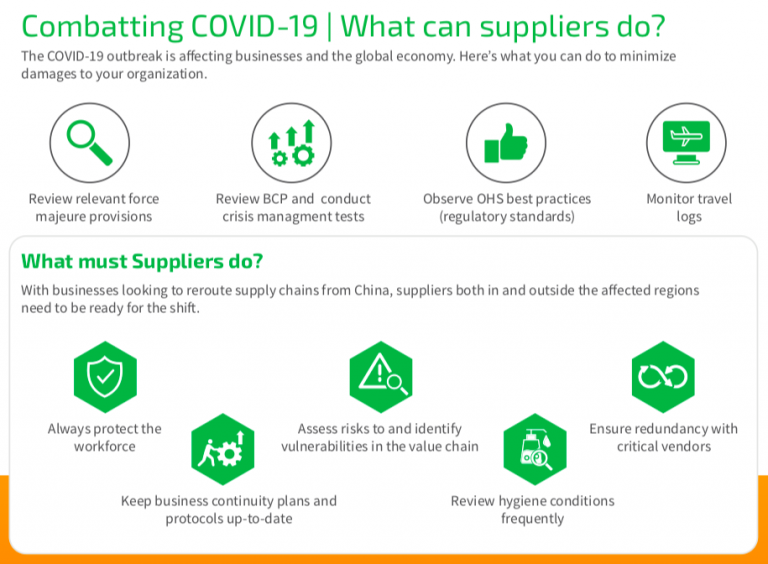
Here I have put down some workable ways and steps for manufacturers to help them equalize their supply chain systems and networks to cope up with the unprecedented changes transitioned worldwide.
NetSet Software is also learning from the effective techniques provided below and is making the best efforts to continue its services without any disruptions amid the corona crisis.

1 Conduct Risk Assessments & Nail the Pivots

Responsiveness, proactiveness, speed, and decision making are the key factors to spin the wheel of success during the critical time of the novel coronavirus spread.
Get connected with the supply chain system partners (logistics service providers, suppliers) and perform the following:
  • Identify
Ever-changing supply-demand variants to act wisely to eliminate the loopholes in supply, transportation, production, and warehousing
  • Define
Goals and action plan feasible as per the temporary crisis. Reform and create result-oriented resilient strategies to maintain the supply chain networks and ecosystems to balance the cycle of supply and demand, deriving appropriate sales and revenue.
  • Deploy
Deployment of products is possible only if the workflow strategies, resources, and manpower are aligned well as per their roleplay and KPIs which will drive the ecosystem’s visibility dynamically.

2 Prepare for Employee Absenteeism

Absenteeism of employees is a real-time situation that manufacturers must be prepared for, looking at the tough time of crisis. The restrictions imposed on travel lowered the availability of local laborers as well as migrant workers to return to work.
This calls to limit non-essential travel and implement flexible and feasible working policies and arrangements for employee safety, keeping exceptions for production line or distribution center workers.
Think practically: Loss of productivity caused due to the fall in the number of working employees (sick leaves, impacted by the virus) can be significantly less expensive than a prolonged downtime from closing an office site, the entire plant, or distribution center. 
It’s better to work less being safe rather than work more with infected persons, directly or indirectly disinfecting the site and causing adverse impacts.

3 Pay Heed to Workforce/Labor planning

Amid the time of the outbreak, restarting operations will present unique challenges as workers gradually rejoin to work. Enterprises need to focus on the considerable measures to resume their business operations and ensure to possess a healthy normal work environment and routine. 
Nevertheless, ‘back to normal’ situations won’t be achieved easily and would take longer than usual. With ongoing restrictions and imposed rules on commutation, it will be hard to ramp up to the full capacity and potential and requires close heed to be paid to labor planning and product quality with the scarcity of both material and required workforce.

4 Set Prime Focus on Supplier Risks

Here comes the need for you to separate your direct suppliers and understand their capabilities to fill the supply gap and meet essential requirements, eliminating encountered risks.
Get clear visibility over inventory, production, and purchase order fulfillment, and understand the possibilities and flexibility of shift production and transport to other locations, dealing with your key suppliers.
Remember, suppliers will treat you from an allocation perspective regarding shortages, outages, and inventory management where you would not only be the last option for them, therefore, you must hunt for alternative ways and plan accordingly to minimize the impact on your firm.

5 Illuminate the extended Supply Network

To keep the Tier 1 running, it becomes significant to pay close attention to the Tier 2 supplier status and beyond, that further impacts Tier 1.
Work with suppliers for alternative plans, alter rules and methods of work wherever needed to keep your business plants running at the maximum efficacies. The traditional ways of working won’t give fruitful results within the prevailing unprecedented circumstances.
Establishments with complex supply chain networks, systems, and hierarchies need to extend and scale their approaches and techniques to alleviate supply-side risks, embracing digital modes to enhance the network for gaining a clear view of critical components of the supplier network.

6 Apply Digital and Automated Approaches

Endorse smart digital methods in communication and other manufacturing operations to mitigate reliance on labor-intensive roles and workflows. 
Businesses, today, must favor digital technology to aid standardization of routine work and jobs, done remotely or physically, as they can reduce the dependency level of relying on individuals to run elementary operations.
Artificial Intelligence, IoT, big data capabilities can bolster your manufacturing systems and foster a digital ecosystem of connected devices, rendering relevant and useful data in real-time, thus enhancing decision making.
Automation will help you reduce manual and repetitive tasks and enable you to run business operations with interchangeable shifts of employees, lowering labor needs. 

7 Identify and Proceed with Alternate Sources of Supply

Amid the troublesome situations, one must look for secondary ways to enhance supply sources and secure capacities and inventory and grab opportunities for resource pools to gather raw materials.
Look out for non-impacted areas for alternative sourcing markets with supply chain and manufacturing expertise, exploring the diversifying geographical location beyond the boundaries of China. (Most likely markets include, Brazil, Mexico, Chile, etc.) 

8 Reshape Inventory Policies and Parameters

The demand and supply variability has inclined differently, where the rules, policies, and practices followed earlier would not deliver productive results.  
There arises the need to consider and mark the ways to refine inventory strategies to reduce the adverse effects on business due to supply shortages and risks, equalizing the basic factors like cash flow, supply base risk, perishability, etc. on an immediate basis. 
Set safety stock parameters to buffer the demands and supply variabilities with delineate planning and precision.

9 Enhance Inbound Material Visibility

In this step, you need to acquire insights about delivery performance from the supplier’s end. Expect delays and declines in the delivery status and type (on-time and in-full respectively).
You need to make efforts to acquire the visibility of inventory status at supplier’s production, schedule, delivery, location, and shipment in order to predict the supply gaps and disruptions likely to occur.
If you lack digital connectivity with suppliers over the inbound flow of products and materials, you must get access to data and management tools to enhance business visibility and feasibility of trading amid the corona outbreak, further empowering decision-making skills.

10 Pay Attention to Production scheduling 

Create an agile and adaptive environment and prioritize the products to accelerate sales in the event of raw material shortages. Refine your production schedules as per the availability of resources and manpower to reduce the expected disruptions in the supply-demand concept of trade. 
Take care and ensure that the production of the crucial part or component and your capabilities to build them without experiencing the risk centered situation of going ‘out-of-stock’.
There might be many small and medium enterprises that might not possess the necessary tools for calibrating re-planning and scheduling, and for them, Supply Chain War Room becomes the critical need as a short-term solution in the present time.

Final Say

The spread of the deadly virus is impacting communities, supply chains, ecosystems on a whole which calls for global scenario planning. This involves understanding the potential risks seen as per locales, regions, and nations and determining appropriate actions and steps to proceed to mitigate ourselves from the posed threats.

Supply chains today face a disruption risk not seen since World War II.

The experience of affected countries in the first wave of COVID-19 shows that avoiding disruption in supply chains is key to ensuring food supplies to a quarantined population, as well as providing medical supplies to health centers to combat the pandemic. At the same time, the operation of these chains contributes to reducing the serious impact on the economy, keeping some of its sectors active.

Tuesday, 5 May 2020

How to Use Blockchain in Developing Video Conferencing Apps like Zoom or Google Duo?


How to Use Blockchain in Developing Video Conferencing Apps like Zoom or Google Duo?


When anybody says Blockchain, people usually associate it with Bitcoin, cryptocurrency, etc., unknowingly that this cutting edge technology can be leveraged beyond the realm of finance.
The technology has managed to separate itself from its beginnings and the economic interest generated has made it go beyond the financial services sector, reaching the utilities, transport, commerce, and public sectors, and many more. 
“With forecasts to generate 3.1 trillion dollars in commercial value globally by 2030Blockchain is one of the technologies of the moment.”
Fundamental Functioning of Blockchain:
 “Blockchain is based on a decentralized and distributed technology paradigm that allows the exchange of any type of value between participants without the need for intermediaries. The interesting thing about this technology is that you do not need a third party to guarantee what is happening within the network and its participants.”


Blockchain Powering New Era of Communication

Organizations that have been researching blockchain in recent years have now started to launch their systems, taking both customers and competitors with them. Given its potential to accelerate the flow of data and eliminate administrative expenses, blockchain allows to dynamize processes in the same way as to reduce costs.
Blockchain is an emerging technology that eliminates the drawbacks of the available solutions which are unable to figure out security issues. Surprisingly, the most popular app of today, Zoom Video Conferencing has some serious security challenges to face that pose a threat to user’s data privacy.
Mobile development with Blockchain has gained enormous popularity where many top mobile app development companies have invested in developing robust and secure digital solutions for both web and mobile apps, exploring the abundance of blockchain.
With an increasing number of possibilities of developing distinct video chat apps or video conferencing apps, creating a concrete security-proof wall against its vulnerabilities of risks becomes the primary concern in the app development.

#Major Security Issues a Developer has to Deal With

  • Weak server-side controls
User and app communication occurs mostly outside the smartphone over a server which becomes the major point for hackers to target
  • Data storage lacks security
An app developer usually depends on the client storage for data security; nevertheless, if the storage is not provided a sandbox environment, data can be accessed and manipulated with ease
  • Data leaks over insecure locations
Unintended data leaks may occur when the data gets stored in a location on the device and gets prone to unauthorized access. Occurs mainly due to OS bugs or security issues with storage
  • Poor authentication or authorization
Weak or no authentication during both offline or online modes opens up the gateway permissions to users as well as hackers that enables them to execute actions, originally to be performed by admins or super-admins
  • Client-side injection
The underlying frameworks that bolster mobile apps are the major sites to inject malicious data. They interpret the bad data as existing device data and treat them as executable files.
  • Provision of privileges
Privileges expand as the network expands, more the grants given for code access, more is the possibility of disaster
With all these acknowledged, here comes blockchain development, the newest best technology that keeps the potential to overcome all of the security hiccups in mobile app development and gives an upper hand to programmers by eliminating all those aspects that center on the objective of a middlemen/third-party.

#Data Storage & Security Mitigated by Blockchain

NetSet Software draws a baseline empowering blockchain to avoid all the security limitations of a video conferencing app, implementing high-level use cases of blockchain technology that can solve the major concerns of the existing app problems.
Utilizing the concepts and working principles of this robust technology, our blockchain programmers build highly authenticated video apps where data is stored on a single registry, agreed, and distributed over several nodes within the same network.
“Blockchain peer-to-peer networks eliminates intermediaries.”
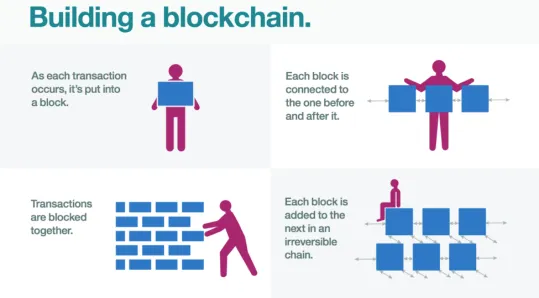
The basic idea is made easy to follow. A series of elements are stored in each block of the chain:
  • A number of valid records or transactions
  • Information regarding that block
  • The link with the previous block and the next block, called hash and that works as a fingerprint of each block


Source: tutorgram.net
Blockchain is a completely different approach!
A blockchain P2P network is a distributed network that stores and transfers data without any essential single controller. Blockchain technology is built on a P2P concept, having no centralized information of storage that makes data less vulnerable as compared to traditional models. 
P2P Networks in blockchain are considered as a huge improvement over the conventional centralized servers and are highly secured for data storage and ownership especially in the public domain.
“We develop enterprise-grade solutions, embedding crypto-based transactions, and featuring peer-to-peer content distribution using platforms like Ethereum, Hyperledger, and Smart Contracts.”
Distributed ledger technologies such as blockchain offer a way to conduct transactions in a secure and verifiable manner without the need for a trusted third party. 
As such, it is widely believed that blockchains will significantly impact industries ranging from finance and real estate to public administration, energy and transportation, and many more.

#Video Communication Enhanced by WebRTC

While building a new universe of communication, enabling faster connections, HD images, high-rated video quality, there was a need to provide a hard communication base for offering multiple-functionalities within the app.
Our adroit programmers leveraged the blockchain technology along with WebRTC to build a Web & Native based Video-Conferencing (VC) application that assures high QoS and adds the benefits of Blockchain as a key component that differs from other existing solutions.
A major limitation of all the existing solutions is that all of them are basically leveraging a client-server model that uses a single center controller to handle all operations of streaming, storage, and authentication, like central authority to share and manage information or services. 
This model has some serious problems, for example, all the private data stores in one location or gets copied on a few other locations. Next, Data can be compromised by hacking one server and can be prone to intrusions. 
WebRTC becomes the first choice of web and app developers as its open-source and provides seamless APIs to integrate within a mobile application:
Significant APIs of WebRTC:
  • RTC Peer Connection
    Audio/video data transfer made possible with encryption support and access control
  • Media Stream
    You get access to chat from webcam or microphone
  • RTC Data Channel
    A P2P communication network for data generalization is offered.

Key Technologies Involved to Build a Video Collaboration App

  • JavaScript, 
  • Java, 
  • Node. js. 
  • Hyperledger Fabric, 
  • WebRTC

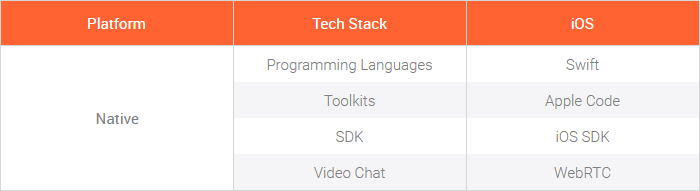
iOS Video App Technology Stack


Android Video App Technology Stack


Must-Have Features of a Video Conferencing App

A video app must fulfill its intent by performing its basic tasks efficiently without any downtime issues, within a defined interval of time.
  • Easy User Registration
  • Smooth Profile Creation
  • Contacts Management
  • Prompt Chat Messaging
  • High Definition Audio/Video Calls
  • Uninterrupted Group Calls
  • Trouble-Free Screen and Desktop Sharing
  • Pop Up Notifications
  • Cloud Synchronization
  • End-to-End Encryption

Business Use-Cases of Video Conferencing Apps 

Video conferencing app is another name for instant connection to be made effortlessly for remote communication with peers, clients, customers, and family. 
Undoubtedly, a video app (for both web and mobile) is the need of the hour to build a reputation among clients and is a requisite asset for collaboration in the workplace. Check out the business use cases of a real-time video conferencing app:
-Banking and Finance:
 Build trusted relationships while saving time and money
-Education: 
 Bring the world into your classroom with video
-Government and Public Sector: 
 Reach underserved and remote areas without wasting time or resources
-Health Care:
 Extend the reach of health care and access the inaccessible
-Legal: 
 Enhance client service and case preparations
-Manufacturing: 
 Streamline operations and expedite production times
-Media and Entertainment: 
 Showcase your projects in true-to-life 4K quality
Final Consideration
Blockchain technology can be leveraged to a great extent and developing a video conferencing application is one of its feasible outputs that is experimented outside the vertical of finance.  
With a blockchain-powered video communication app, we aim to build and revolutionize a modern communication medium that fits into every possible purpose of real-time conversations done remotely that facilitates one and all.

Wednesday, 22 April 2020

COVID-19 Outbreak: Empower Your Business Continuity Plan(BCP) Remotely | NetSet Software


We’ll overpower COVID-19 and come out of the health crises, finding ourselves in a New Business Reality!
NetSet’s higher authorities are striving to empower employees in this hard time of crisis and have come up with an effective Business Continuity Plan of action
We issue this note in public interest, acknowledging all our esteemed clients and customers for continuation of our IT services and business operations via remote work, simultaneously, keeping our staff’s safety intact.
We believe this is an excellent time to draw on the capabilities using the power of Work From Home (WFH). We have kept ourselves operational-ready to combat any similar crisis and lockdown situations.

How NetSet is Practicing Remote Working and Ensuring Continuous Productivity?

To fulfill commitments and to ensure continuous productivity, we haven’t let Novel CoronaVirus to cleave our online services. We are clearing hurdles coming our way by employee-friendly and safety measures:
  • All employees equipped with software/hardware essentials to work remotely
  • Weekly boosters delivered on part of work delivery along with health safety
  • Flexible WFH policy followed and practiced throughout our global offices
  • Daily updates sent to peers on noteworthy changes and alerts
  • Open Door Policy gives employees freedom of speech
  • Ensured working of Happier, Comfortable and Safe teams
  • Powerful tools introduced to monitor security of sensitive business data
  • Continuation of adding add new clients and customers

NetSet’s Operational Readiness

We have facilitated our counterparts with all the requisites to work from different corners of the world.
#Smooth Communication
  • Skype
  • Google hangouts
  • Verbal Communication (as & when required)
#Effective Time Management
  • Hubstaff
#Project Management
  • Basecamp
#Code Management
  • GitHub
  • Bitbucket
Our Remote Team is Safe, Protected, and Proactive as ever! We never forget that our employees are the most valuable assets.
Our Services are as Flexible as earlier where we expect no disruption in rendering them as and when. We have made our team learn how to become Remote First, Fast and Furious for healthy business implications as we move ahead.
We hope and pray that our globe survives this pandemic and get back to normal routines likewise in 2019.