Thursday, 17 September 2020

Agile Methodologies: Future-Proof your Business for a Digitized World

 Agile Methodologies: Future-Proof your Business for a Digitized World

Revolution 4.0 brought breakneck speed to work processes. Organizations thinking of fully embracing digital transformation must do their homework. Among the most important tasks is the adoption of agile methodologies that allow products and services to be delivered quickly with a significant reduction in cost and time.

For this reason, it’s important that custom software development companies know how to implement the agile methodology in their business.

A Dynamic and Changing Environment

With the ongoing time of the crisis, many have understood that the barriers that were maintained in the past within an organization were more psychological than real. 

The digital environment has become very changeable and dynamic. Within this scenario, companies must continue to fulfill their main purpose. We are living a time of personal and professional change and absolutely disruptive in the way we face our company life.
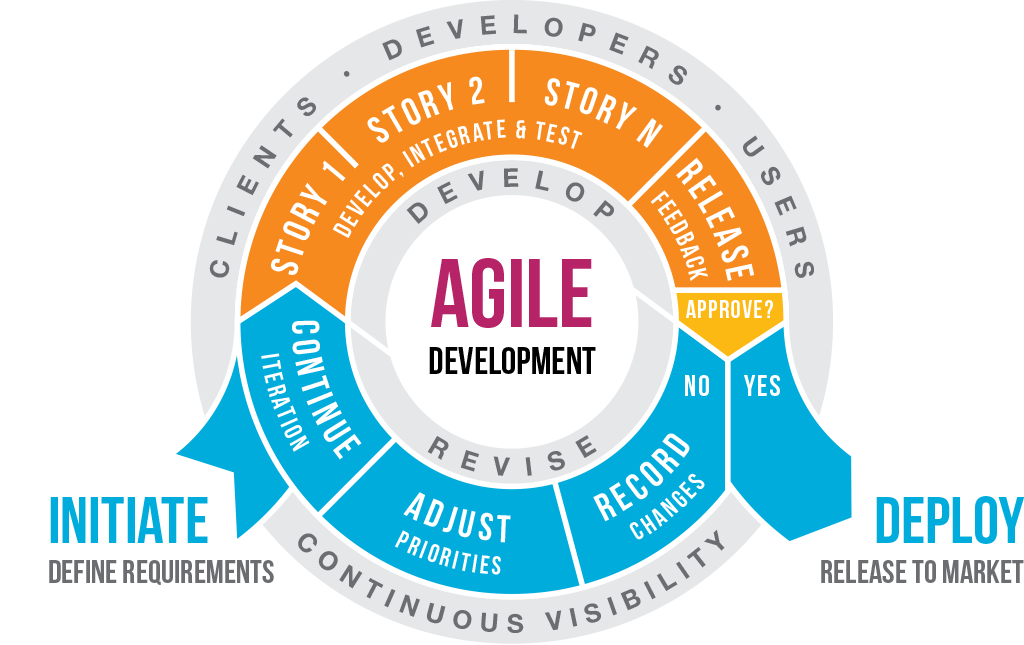
The need is to realize that advancing technology, agile methodology, and digital training are the key elements in this sphere. In this case, it is about their management being adequate to improve productivity and be more competitive.

The moment in which we live returns a corporate reality in the process of transformation. Organizations are trying to get rid of their analogical conception and establish themselves in digital.

Completing the formalization of this transitory state is an inevitable process. Companies that do not understand it this way will lose all their visibility in a completely renewed and technologically advanced market.

Presently, the most likely used words to be heard and implemented are that of Agile Methodologies. It is probably the most popular software development methodology in the world and it is getting more and more followers in companies and technology departments.

Most of the custom application development companies have fully implemented Agile techniques. Although generally related to web and application development, agile practices can be implemented in almost any team and any business sector, helping companies grow.

The Antique Technique: Agile

Agile methodologies are those that allow adapting the way of working to each project carried out by big, medium, and small companies. Being agile, in short, is having the ability to respond quickly to any situation and emerge beneficially from changing environments.

If this concept is adapted to the business framework, agile methodologies are born, which allow making any project flexible and easily adaptable to any situation, thus achieving the best results, in record time, and reducing costs.

[Prefer Reading: “Growth Hacking: A One-Stop Solution for Rapid Business Expansion.”]

Advantages of Applying Agile Methodologies to an Enterprise
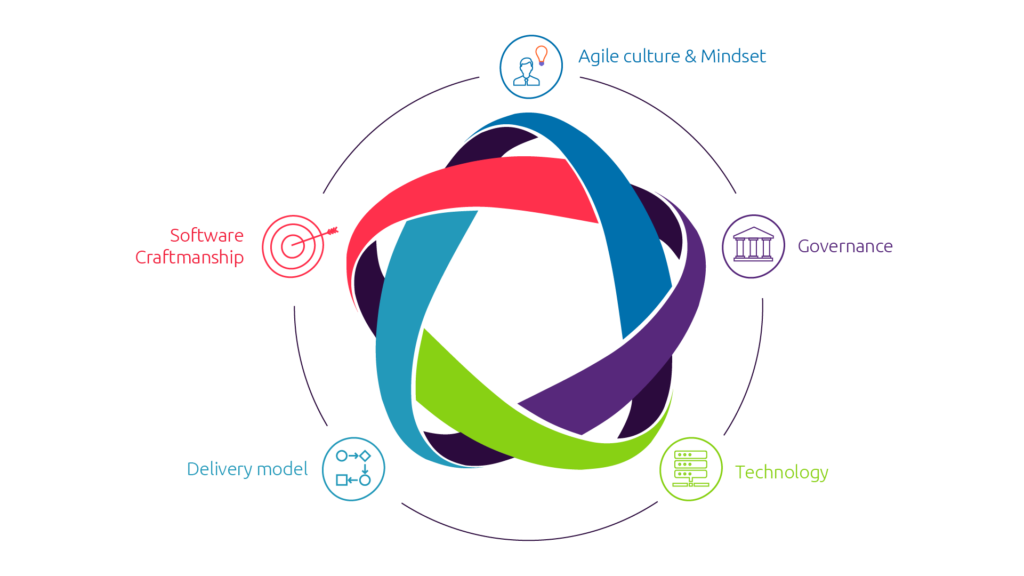
Applying digital methodologies to your software development outsourcing company can have many benefits and advantages, but in broad terms, we present the following three:

1. Versatility to Achieve Goals

The management of projects in companies that have implemented agile methodologies is not pre-established nor does it respond to patterns, but is completely oriented towards meeting the objectives and new goals that may arise.

In this way, the project adapts to the client’s needs and better results are achieved!

2. Greater Customer and Team Satisfaction

As we said, a project managed by a web or an app development company that applies agile methodologies is a project that adapts to the client’s needs and pursues the achievement of all its objectives.

This type of management will generate greater customer satisfaction since they will be involved throughout the project. You will be a participant in decision-making, you will be informed of its achievements and shortcomings, and you can contribute your global vision to improve the final product.

The work team, in this type of management, also feels more accomplished, since at all times they have a global vision of the progress of the project and can also contribute their point of view.

A collectively developed project brings benefits to a business and the customer!

3. Better Product Quality, with More Efficiency & Lower Costs

As we said, a project that is developed taking into account the opinion of the client and that of those who are building it does nothing more than improving the final product. The interaction and taking into account many voices means that there are more voices to question how to improve the final result and detect any errors more quickly.

In addition, it works with greater efficiency and speed and therefore, costs are reduced. The development of a project using agile methodologies entails delivering many versions of the product until arriving, less time, at the final version applying all the necessary corrections that the client requires.

[Prefer Reading: “Are We Technology-Ready Post 2020 Pandemic?”]

5 Agile Methodologies to Implement in your Company
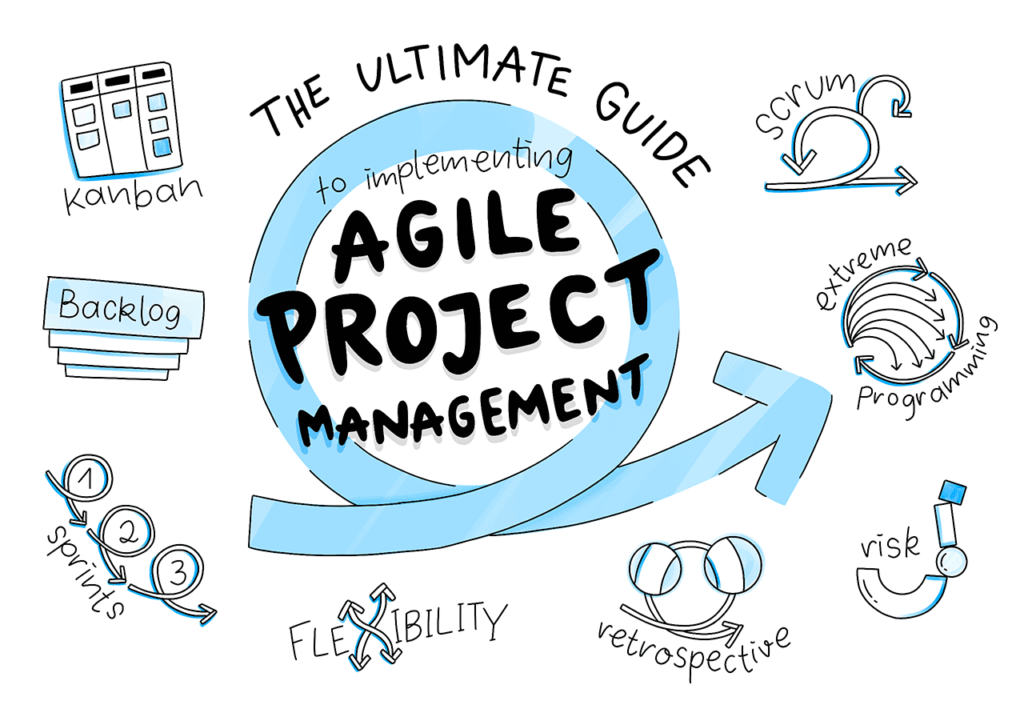
At this point, you may be wondering: how can I apply agile methodologies to my company?

How can I create a custom mobile application applying an agile methodology? 

#Extreme Programming XP

If your company, or SME, or startup is in the process of creation or is still consolidating in the market, this is your perfect tool, since it focuses on personal relationships between team members and with clients.

Its main objective is to enhance personal relationships, both within the company and with the client, to encourage teamwork, and improve the final result of the product. 

#SCRUM

This methodology consists of breaking down any product development cycle into smaller products. In this way, the development of complex projects that require flexibility and speed is facilitated. 

By fragmenting development cycles, you can meet small objectives and submit them to validation by the client and the work team, to more easily detect errors or proposals for improvement. Communication within the team and with the client is essential in the application of this agile methodology. 

#Kanban

This agile methodology is very useful for leaders or those responsible for projects since it consists of visually reflecting pending, in-process, or terminal tasks. In this way, with a glance, the project manager can get a global idea of ​​how the team is working and if it is managing the project correctly. 

In addition, this graphic must be available to all workers on the team, because this way you avoid overlapping in tasks and organize your time. With this agile methodology, productivity and teamwork are improved. 

#Agile Inception

Achieving a consensus between partners, between work team or with the client is often complicated, but this agile methodology is intended to facilitate it. How do you get it?

It consists of holding repeated meetings aimed at defining and clarifying the most immediate objectives to be met, in which interventions cannot last more than 5 minutes. In this way, a clear and direct message is delivered and it is easier to reach a consensus. 

#Design Sprint

This agile methodology is promoted by Google Ventures, a Google service, and has the objective of shaping everything that involves the project in record time, ideally in 5 days. It allows us to prototype and validates ideas with the work team and with the clients to define the tasks and stipulate 5 phases to route the product.

As we all know, a sprint is a race at maximum speed, and this term applied to product development means the same thing. By applying the Design Sprint you will promote teamwork while reducing work time!

Thursday, 10 September 2020

Are We Technology-Ready Post 2020 Pandemic?

 Are We Technology-Ready Post 2020 Pandemic?

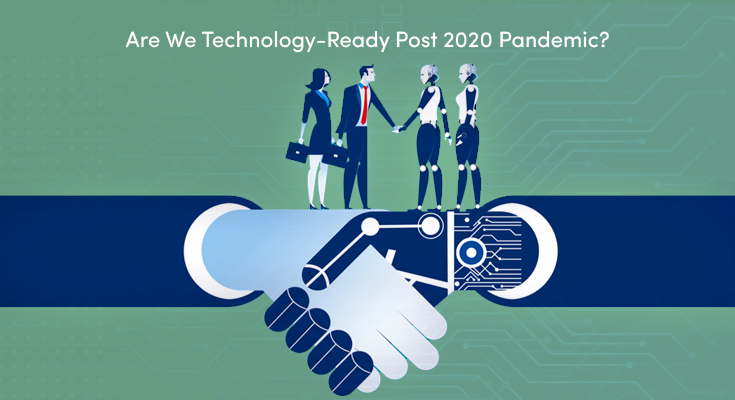
With the sights set on returning to the new normal as soon as possible, technology has emerged as an essential tool to avoid stopping any activity in its track. 

Certainly, we are not unaware of how technology allied with humans to overcome the Corona crisis where drones were flown to drop medicinal aid, UV-based AI-robots were used to sanitize hospitals, powerful machines and apps were established to detect virus symptoms, live map trackers were deployed to check current active cases, death counts, etc.

Now, what next?

Is still technology primed to cope with the aftereffects?
Can humans rely upon the robust advancements being made in IT, Tech, and Science, anytime soon?

The answers to these questions are revealed as we roll out further.

Undoubtedly, the unprecedented situation, pressingly, demonstrated the significance of digital readiness and lead us to adapt ourselves to the New Normal.

There are several changes prevalent in recent months as a result of the pandemic. One of the most important is the telecommuting boom which has grown from 7% before the pandemic to more than 70% today.

And I guess, you must be among one of us working remotely, not allowing any of your services to be disrupted for your online business.

Looking at the other side of the population there are many who were unfortunately forced to reduce or suspend their operations and this is what reasoned for accelerated development of several existing and emerging technologies.

“A Catastrophe or a Crisis can act as an Accelerant that can Speed up Changes that are on their Way.”

The Web was a boon since its inception and the same can be said in the year 2020 where the Internet offers several ways for all offline and online businesses to improve their sales during the emergency time.

How We are Racing to be Future Ready with Technology?

#1 Remote Healthcare

While remote healthcare checkups and telehealth services were a resistance before; however the intervention of remote technology in healthcare has and will further change the history of this domain.

Telehealth was accepted by people quite early but its growth was a bit slow, were about only 10% of the US residents replaced doctor visits or hospitals with telemedicine services a year before the occurrence of the pandemic.

“Teladoc, the largest stand-alone telemedicine provider, reported 50% week-over-week growth in its services the week after isolation orders were implemented across the US.”

The years preceding 2020 will follow a new tradition of ‘Test, Track, and Trace’ that will encourage the adoption of health monitoring technology. With experts stressing the importance of digitization, wearables, and other health monitoring systems will become frequent to use.

Such IoT-based devices will be able to track vital signs of the deadly virus. Such e-devices will be powered by robust software that will connect devices/systems, data networks, and applications.

Access to care is one of the biggest challenges in the pandemic; nevertheless, this will be soon eradicated, bolstering telemedicine firms and enterprises with essential resources to make the requisite technologies a reality.

#2 Enterprise Virtual Reality

With the stay-at-home orders being imposed on everybody, youngsters and kids along with the adults were stuck finding ways to keep themselves away from idleness. It was then when the masses found out an amazing alternative to avoid boredom and stress. 

VR headsets were used to play video games, explore travel destinations virtually, and ultimately became a great way of online entertainment when they exercising self-isolation. 

In the coming years, many big ventures will be successfully able to experiment with the VR platforms to train employees, connect them virtually, hold conferences, and associate them on projects using all the excellent features that could be added into the VR-enabled apps.

The results of tech advancements could be seen at present times where Virtual Reality has already being used to facilitate training in the field of healthcare. Oxford’s Medical Simulation system is a real-life example that is used to train a large number of medical staff on treating fatal diseases like that of the CoronaVirus.

source

Although technology experts are still pulled back by the drawbacks of AR/VR hardware in the line of battery life, storage capacity, and computational capacities, nonetheless, they are soon on the way of elimination.

[Prefer reading: “How Does Virtual Reality Actually Work?”]

#3 Remote Learning Technology

As of mid-April 2020, 191 countries decided to implement school/university closures, which is said to impact 1.57 billion students around the globe. Many educational institutions began offering online courses because of quarantine. 

With such adverse effects being seen on the future of the global youth, technologies that converge in distance learning were seen as rays of hope and were applied in remote learning seen analogous to remote work. The concept was bolstered by cutting edge technologies of virtual reality, 3D printing, and AI-powered robots as teachers, machine learning apps, etc.. 

Remote Learning Technology

Not only this, but many tech geeks are also continuously hunting for ways how they can successfully implement technology at its best and one such example is set by Yoshiyuki Kakihara who desired to use technology to bring out a solution on English language education for students who were not well-versed with the language.

He created an AI-powered app named Terra Talk that enables its users to have audio conversations. The app is so invented that the Artificial Intelligence algorithms are can hear the students speak English, understand what they say, and react to their speech, giving them feedback. 

Thus, setting a perfect example of turning “Ideas into Reality” Yoshiyuki is in great hope to make further advancements in the near future, leveraging the evergreen technology of Artificial Intelligence and is subsets.

#4 Enhanced Digital Retail 

Online shopping was witnessing a rise, but the COVID-19 pandemic spread it extensively, transforming it into an essential service around the world. It’s true what many believe that a pandemic can merely boost the trends that were already underway.

Today, online shopping is supported by a strong logistics system. 

Enhanced Digital Retail

The pressing concern of in-person deliveries, which are not virus-proof, enabled many companies to make a transition towards launching “contactless-delivery” services, where goods are picked up and dropped off at a designated location rather than hand-delivered. 

Amazingly, in some places, the deliveries can be seen completed by flying agents Drones, thus, eliminating the need for an individual’s actions.

With even groceries going online, many retailers and marketers have found significant ways to get their business running on the e-platforms. The overlords of the eCommerce domain, Amazon, Walmart, among others, invested high in integrating with the emerging technology of automated fulfillment. 

Moreover, they are likely to widen up their share of the online grocery market by augmenting their online grocery shopping experience with technological innovations like a 3D rendering of items as well as customer service improvements and faster delivery times.

While the small ones in the race took aid from third parties to invest in automation, minimalizing the chances of non-availability of resources as well as products in the tough times.

In the heading years, many enterprises plan to make a shift towards investing in technology, and thus, availing the facilities of extensively automated machines and sophisticated robotics. 

Large e-commerce companies around the world are increasing their development of robot delivery and waste recovery.

[Prefer Reading: “Growth Hacking: A One-Stop Solution for Rapid Business Expansion.”]

#Virtual Customer Service

We are all well known to chatbots and virtual assistants and have also seen their use when the humans were restricted to work and were forced quarantine for their safety. While humans were are rest, bots were at work. 

Virtual Customer Service

Understanding the need for customer interaction, many industry-specific companies, and retailers embraced virtual assistants and chatbots, realizing their broader aspect of making business.

Considering serious concerns of logistics and eCommerce businesses faced during the high time of lockdown, many companies decide to rely upon conversational agents as the equation between supply and demand becomes complex.

Even though the situation has been handled to some extent at present, what about the future plans that deal with such unforeseen chaotic situations?

Yes, we are ready!

Joining hands with technology, we are ready with the automated screening tools that are capable enough to determine whether patients need in-person medical aid.

We are ready to employ conversational AI Chatbots to automate the routine tasks formerly handled by administrative employees.

Customer support, retail, eCommerce, banking, logistics, etc. we have covered them all by deploying Automated Software Systems and Rapid Response Virtual Agents.

As a business continuity service, we are up with Cloud-based call centers which offer special virtual call center capability to maintain support operations while witnessing any out of the ordinary situation. 

  • Bright Pattern, a provider of next-generation SaaS Customer Service Management solutions is providing aid to companies who seek support to manage their customer interaction and support activities through virtual call centers.
  • Telephone TriageLogic software and services launched a virtual call center platform and have offered it to various healthcare organizations to deploy virtualized support systems, including HIPAA-compliant cloud-based telephony services.
  • Wix, website creation and design platform, established a virtualized cloud-based contact center for Israel that helped more than 11k Israeli citizens during its initial three days of service and is expected to do wonders in the coming years too.

What Else Can We Expect in Our Expanding Digital World?

“TOUCH NO MORE”

This will be the principle followed in the proceeding years while implementing the following, taking the best care of social distancing and contactless services.

#Connected lift: 

Allowing people in flats, apartments, and office buildings to call ahead and indicate the floor they want to go to using a smartphone app.

#Smart appliances:

Microwaves or coffee machines that can be controlled with voice commands will be a good fit for offices.

#NFC-based tags: 

Tags that can enable contactless payments at toll plazas, parking spaces in office complexes, or even in markets.

And much more coming next!

Thursday, 27 August 2020

Python vs Java: Battle to Win Over Characteristics, Features & Performance

 python vs java

When the talk is about developing lightweight, unique, and specific web or mobile applications, the professional realm of programmers gets to choose among a pool of different and amazing programming languages.

The development of algorithms, the production of efficient code, and numerical experimentation are already a part of the circular baggage of the professionals most in demand by the market where Python and Java have emerged as benchmarks.

The robust languages of today, Java and Python, monopolize much of the attention in the training stage as well as the development stage, considering the different productivity metrics of each.

Java-Python Face-Off

Java vs Python: the developer community worldwide has a great debate about which of the two programming languages is the best where each developer defends his point of view to make a wise decision.

This article will objectively analyze the characteristics of the two unique object-oriented languages that will enable you to have a criterion to choose between any of these trending languages. 

Python vs Java for mobile app development is the next big thing that arouses curiosity among developers as well as non-developers to gain crucial insights into the potential the two vigorous languages embed. A piece of information i the same context is also highlighted as you read along.

Recently, Python emerged as a more advanced programming language than Java and started a debate between Java and Python among developer communities. 

Let’s see which one rules out as per productivity metrics.

Some time ago, software developers developed their systems in a C-class environment and programming languages. After a few years, Java emerged on the horizon as a better option with unique advantages. For example:

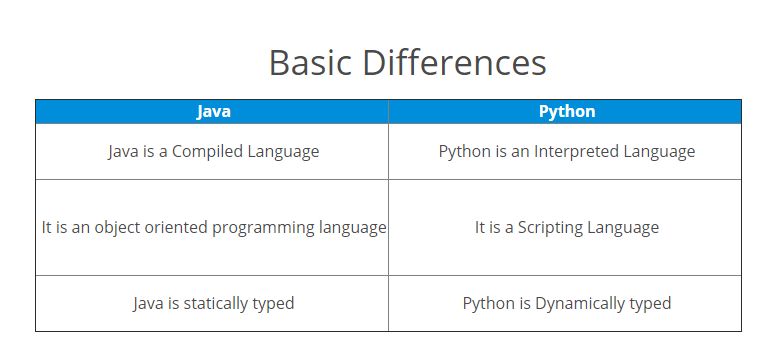
  • Java is a compiled language
  • Java requires JVM (Java Virtual Machine) to run codes
  • It has better OOP support, and possess compact and comprehensive encoding patterns
  • The language has powerful libraries which allow developers to go beyond the desktop, the web and even mobile application development

Lately, a powerful and advantageous new programming language appeared which none other than Python.

  • Unlike java, Python has interpreted the language
  • Thus, Python doesn’t require a virtual machine to run the code
  • Python code is directly interpreted by machines and is converted into a byte code that devices understand 

These were some fundamental differentiators of the two superstar programming languages. We’ll further help you to enhance your knowledge by providing more information on their advanced features.

Let’s proceed.

Which is More Fashionable? Java or Python?

How often people search for language tutorials and learning courses on Google.

#Java Trends

Java has passed its half-life and is getting old to gradually fade from the trends in the programming market. However, the popularity of Java in business and mobile application development is immense and non-ignorable.

-Among the static types of programming scripts, Java is still the king.

-Java is a well-defined language, so you can’t write code without first defining a class.

-Being an amazing OOP language, the mentors who prepare developers are prescribed to learn Java first. Thus, a developer can get used to the latest coding styles, patterns, and best practices.

-Java is a multithreaded language and runs an 8-core CPU.

-Due to tough competitions in the market, genuine Java developers are making it compact in code, coding faster than ever, and are providing more flexibility than previous versions.

-Thanks to the powerful JVM, coss compatibility between platforms and devices is incompatible and unbeatable in the market.

-Thus, 90% of fortune 500 companies prefer Java.

-Google has selected Java for its Android platform from the beginning because of its immense benefits both in the technical and general sense.

The Most Utilized Languages shown by Github’sstatistics

#Python Trends

Python is currently gaining astonishing growth and popularity in rich and developed countries where people are open and can afford future technologies such as AI, IoT, Machine Learning, and Big Data-based application development as well as implementations in innovative startups.

-Python is very useful in desktop applications, web applications, network servers, and media tools.

-Python is great for improving developer productivity, providing flexibility in the language, having excellent library support, and easy to learn, particularly who knows at least one OOP script like Java.

-Python is single-threaded due to its global Global Interpreter Lock (GIL)  and runs on a single CPU core at the moment.

-Python is a favorite language among the next-generation developers and the demands of Python developers are greater than those of Java which reasons why Python developers earn a higher salary than Java developers.

-Python encoding requires fewer lines of code to express the same in Java.

[Prefer Reading: “10 Unforgivable Mobile App Development Basics Mistakes Everyone Makes.”]

Comparison of Performance Aspects of Python and Java

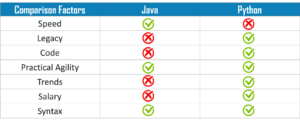
When we technically say that Java is using a virtual machine (JVM) to run code on any machine, we know that it will always perform fast. Interpreted programming is always slow in performance. Therefore Python is still slower compared to Java.

Unfortunately, this is not always true. As a general rule, the performance of languages ​​depends on the environment. Other issues to consider are the types and power of libraries, coding styles, and the applied paradigm.

Python supports multiple paradigms like functional, OOP, and a combination of them. Whereas Java is only one and it is OOP. However, if you have developed an application in Python but when you are going to scale it, you must enter Java. So performance becomes a complex metric in a sense, and direct comparison to Java is a nightmare.

Market Share and Community Support Comparison: Java vs. Python

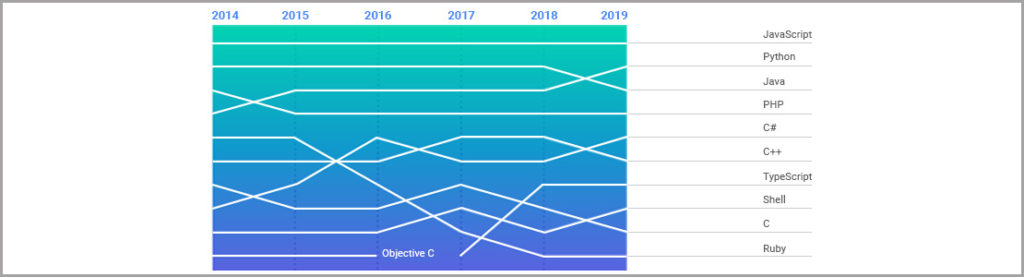
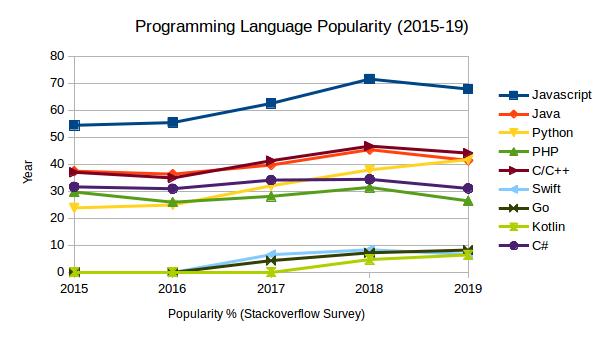
When thinking about the market share of a language, reliable market surveys are useful tools to know. According to these surveys conducted two years ago and in the current year, we have observed that Java remains at the top, while Python in 2017 ranked fifth, but in 2019 it is next to Java.

Surveyors have considered the popularity of a language based on its demand from recruiters in terms of the number of job openings in a period. Hence, we can say that the differences are slim between Java and Python.

Another metric for comparison is the developer community. The higher number of community members for one language than another indicates how the developers have adopted it and what great support you can get from the community.

Without a doubt, Java has a larger developer community than Python in terms of user groups. Those groups are available on various technical forums and platforms. They are also capable of extending helping hands to another developer, either for free or at a reasonable fee.

One more fact should be revealed here when we compare the popularity of a programming script. Some programming niches are better suited for a particular language than others.

[Prefer Reading: “Mobile Application Security: Best Practices for App Developers.”]

Multilingual FTW for Java and Python

Today, “full-stack” development is a buzzword in the market. It means that full-stack developers have capabilities to work across multiple languages, platforms, and frameworks, therefore a team of developers may prefer a particular language when it finds it suitable for particular projects and their goals.

For example, Python is the best bet for data scientists, artificial intelligence experts, and machine learning application development. Java can be great when dynamic/server-side, embedded, and cross-platform application development is required.

Do You Know?

Python is a Literary Programming Language

In the early days, a programming language was used solely for application development, but today it has a variety of applications in addition to development. It means that non-programmers also jump into code without programming skills.

Java has concise syntax and developer-friendly for creating software applications. However, Python is different on this front. It is simple like the English language and easy to code with a smooth learning curve.

Another important aspect of Python is being able to build good coding techniques for a wide range of applications or uses, this means that Python is becoming a popular programming language in technical schools and universities. A student never feels like he is doing special things like programming. Instead, they approach it like writing an essay.

In literate programming techniques, the code, explanatory prose, images, graphics, and other presentation materials belong to single documents, and the code remains executable with the environment. Python supports literate programming environments using Leo and Jupiter Notebook as IDEs.

Therefore, Python, being a literate programming language, excels in several areas such as presentation, demonstrations, teaching, collaboration, and research.

[Prefer Reading: “Which are the Major Forces that Determine the Mobile App Price?”]

Monday, 17 August 2020

Growth Hacking: A One-Stop Solution for Rapid Business Expansion

 Growth Hacking

Are you looking for a technique that tends to expand the growth graph of your business at a recognizable pace?

Are you hunting to find a solution that helps you quickly, and with a few resources to grow the domain of your business?

Then let me reveal that one-stop answer that is synonymous with rapid business expansion.
Growth Hacking!

Growth hacking is no intangible concept which is presumed by many.

It is not even magic that would lift up the growth by millions after a few hours of execution.

Nevertheless, it’s a smart technique that aims to increase the business volume of a company or an organization with a minimum investment of time and money. 

Hacking can bring remarkable progress if analyzed and monitored properly and requires inducing smart marketing and innovative brand-building tactics, utilizing the best technical software, and digital marketing services.

The business techniques you invent, the strategies you apply, and the tools you implement prove effective in growth hacking only if your desire for growth is well defined and indexed with customer-oriented practices.

A Succinct Go Through of Growth Hacking 

If we count the primary objectives of a company, these are the ones which can be counted on fingers and are the most obvious ones:

  • Increased Sales
  • Boost in Web Traffic
  • Ever-increasing Contacts
  • Sky-high Visibility

And, growth hacking can help you achieve all these without stepping out of your financial budget. For this reason, it also accounted to be one of the most effective business strategies used by all the startups amid COVID-19 as they are new in the game and do not possess many resources at their head start.

What all does it combine?

The discipline made its advent way back in 2010 and combines marketing techniques, social networks, product improvements, and web analytics. Although all these seem to be very comprehensive, on practical grounds these are detailed concepts that consume time to deliver expected results.

Currently, growth hacking has expanded and is highly recommended to apply in online businesses, online marketing strategies, and blogs. 

[Prefer Reading: “Digital transformation Checklist for Your Business.”]

Does Growth Hacking Differentiate itself from Digital Marketing?

Both the terms mentioned have unique identities by which we can say that none of the two would replace each other. However, digital marketing and growth hacking are on the same page when the emphasis is laid one experimentation, creativity, revolution, and measurement in order to accomplish the set business targets.

Both the facets of business progression follow the same principles and share the same metrics to fulfill their motive when applied to business or trade:

Increased Engagement, Increased Conversion, Increased Retention!

Keeping the only difference in setting the scope of their goals. And it won’t be wrong if we say that marketing activities can have a broad focus to achieve an overall outcome of the efforts made while hacking can define its goals to receive singular outcomes.

How to Implement Growth Hacking?

Growth hacking can be applied in video marketing, any content marketing company, any eCommerce firm, in short, any company or brand and products or services which keep us to be mindful of the fact that everything relies upon creativity, with which strategies should be carried out and executed.

Thus it becomes vital to know the characteristics of the products, services, brands, along with the traits and behavior of users which highlights the consumption pattern and gives clear insights into the path of exponential growth.

Advantages to reap out the robust concept can be defined with respect to other similar products, comparing them, and offering a plus to the potential users or prospects who have the highest possibilities of converting.

Many strategies come to play when the need is to direct the focus and attention towards the campaign. Growth hacking campaigns such as Referral Strategies, Remarketing Strategies are put to exercise to derive expected business outcomes.

Let’s take rundown at some of the workable strategies linked to derive fruitful outputs with minimum inputs.

Awe-Inspiring Growth Hacking Strategies to Apply in Business

#1 The Wow Effect

One of the best strategies to surprise and keep customers happy and in love with your brand is to attain the WOW effect as it’s a rarely used technique and it always works. 

The WOW effect is based on offering users more than they expect, without asking for anything in return. They can be things as simple as:

-A personalized business gift

-A free ebook 

-Extra after-sales services

-Make a custom call to know how the product seemed to him

Who won’t like to acquire something from a brand/company without asking for anything in return?

On the special occasion of Christmas, Semrush surprised some of its start customers with several gifts. With such an attempt, they managed to make users happy, which made them share the details over their social networks. 

#2 The Acquisition Strategy

This is based on applying the mythical phrase that we all know, “If you can’t beat your enemy, join him.”

This can be exercised in different ways, depending upon whether you are more interested in a merger, participation as a partner or directly buying their part. 

Buffer, one of the most powerful tools in the online world, in order to level up the count of registrations, bought Digg platform in 2012. Digg is a floating bar that is added to websites and blogs and that allows content to be shared on different social media channels.

This purchase allowed Buffer to add its social bookmark to the Digg Digg widget and thereby gain the subscription and trust of all users who already used that platform.

#3 Demo Versions and Free Trials

It is a very interesting strategy that is based on developing a platform that allows users to test the benefits that the tool brings to the business. 

The magical idea here is that it can be used for free without advertising. It simply serves to show that the customer can buy the features/benefits of the product for himself for a limited time. It’s a good way to make a brand known without being intrusive where the brand promotion is indirectly done by the users.

UserLike decided to create a widget that allows you to test the URL of a website and do a simulation of how the software works. With the technique of “try, and if you like it, you can keep it”, the brand acquired 40% more subscribers on its websites.


[Prefer Reading: “AI’s Interference in Digital Marketing.”]

#4 Referrals or Member Get Member

It is a growth hack technique widely used by large companies and is based on offering users a reward or some type of discount when they recommend and get one of their friends or family to register on their platform(s).

This is a good way to engage with users and gain business traction.

One of the good examples is Dropbox, which in its growth strategy, chose to give more free storage space on the platform for each invitation accepted by its friends. With this, the number of dropbox users increased from 1,00,000 to 4,00,000 in just 15 months. 

#5 Integration with Social Networks

If you need to register on a page to use a specific service, it is easier for you to do so if the page has the option to log in with Facebook, Twitter or any other social network, instead of having to do the complete registration process from scratch, something that by the way is very annoying, and who hasn’t had to do this hundred of times.

There enormous brands and businesses that have chosen to bet on this system and facilitate the registration or login using social networks. Here the growth hacking technique simplifies the registration process on a specific page and benefits from the social network databases through which the user registers.

#6 The Power of Contests

If this tactic is implemented correctly, your business will not only grow, but it will also do so in a way that you could never believe.

The working idea is to launch a contest or raffle an attractive product for the community for users to participate in it to create some type of interaction with the brand. It can be ‘likes on Facebook’ or ‘RT on Twitter’ or ‘Follow on Instagram.’

You can use various tools to create contests and promotions where, in less than even 5 minutes, you can post your sweepstakes on Facebook, without having to create a design, program, or invest resources, all while increasing interaction with your fans.

Now that you know a little more about this revolutionary concept, designed to increase the growth of your business, what is your opinion? Are you going to start betting on Growth Hacking? 

Let’s be happy to know your opinion!

Thursday, 13 August 2020

Why Do Businesses Crave for Ionic App Development?

 Ionic App Development

Undoubtedly, an app is the most feasible asset to propagate a business idea that takes a dynamic form bypassing various crucial stages of mobile app development. An app occupies huge potential to develop a wide range of audiences while keeping intact all the essentials of app creation.

There has been a comparison between hybrid and native apps for quite a long time and with the advent of new app development frameworks, they both have entered a new phase that is capable of bringing disruptive changes in the mobile app industry.

User experience, design, and themes, layouts, are the obligatory elements of an app that can be better embedded and enhanced using one of the top frameworks in use, that is, Ionic Framework.

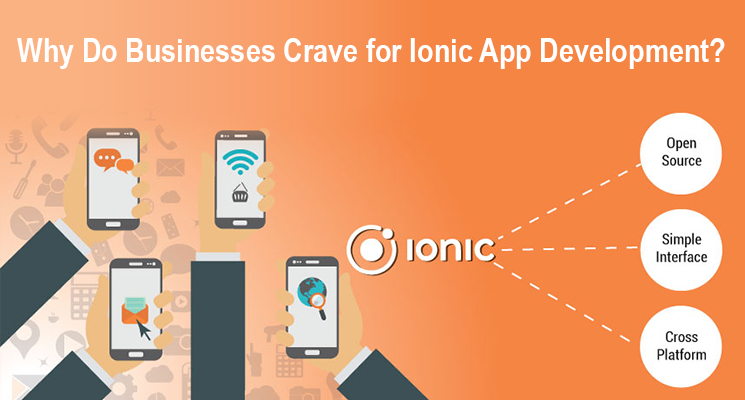
Ionic is an open-source technological framework used in the development of hybrid mobile applications. By combining the HTML, CSS, and Javascript code, we obtain applications with a friendly and intuitive interface for the user.

And not to forget, the most amazing element is developing a single code, it facilitates creating apps for both Android or iOS.

A Quick View of Ionic’s History

The ionic framework is built on AngularJS and Cordova. It was born in 2013 with a sole aim to facilitate the developers to create hybrid mobile applications with the benefits of the two mentioned frameworks.

One of the major advantages of working with Ionic is that it takes advantage of Cordova’s plugins (handling of hardware, software, images, text, QR codes, etc.). In 2016, it was updated to the Ionic 2 version, with modularization, one of the most complete updates of this framework, allowing it to be separated into parts: core, angular, native.

The Ionic 3 update is practically imperceptible in terms of new functionalities, although it does bring new features in its performance.

Continuing with the development and upgraded tools, in version 4, it begins by replacing Angular JS with modern Angular. The component set of this tool uses custom elements the shadow DOM APIs, available in all modern desktop and mobile browsers.

Another novelty that Ionic 4 brings is that it allows to use React, Vue, Angular, or Javascript for the development of programming logic. 

Ionic 5, recently launched on 2/11/2020, arrived announcing these improvements on its page where this version includes iOS 13 design updates, a new API to create your own custom animations, renewed Ionicons, updated ionic colors, new initial designs, improvements in the customization of components and more.

With all these accounting features it has become easier to expose the native functionality to the web application in a cross-platform way. The development of mobile applications with Ionic guarantees that the implementation of the project is much more stable, simple, and with an optimal user interface.

App development with Ionic is mostly the preferred choice and also a recommended option for almost all the startups who seek to build interesting and intriguing applications built with an intention to develop a strong business base and business growth.

[Prefer Reading: “10 Unforgivable Mobile App Development Basics Mistakes Everyone Makes.”]

Why Opt for Ionic App Development?

Today, cross-platform app development has taken all the hype, and frameworks considered best for the same are Ionic and PhoneGap. Out of the two Ionic is the most likely chosen framework for creating native and progressive web apps through a web platform.

Let’s check out some more benefits that Ionic tends to bestow upon us:

#1 Native App Creation, Feasibly Possible

The wish of startups to develop a budget-friendly native app is granted by the holistic framework of Ionic which is no less than an extraordinary trait. Ionic either can provide Ionic’s native plugin ecosystem or can lend an aid through the native wrapper.

Developers can target potential audiences with ease and can readily build native apps for any operating system.

#2 Single App, Double Platforms

Simply put, a single app developed in Ionic can serve the users of both Android and iOS. The rising concerns here are only focussed upon the mobile app development cost for SMEs as it will tend to cover a huge monetary value as unexpected.

Even though the app budget is a heating concern, Ionic business apps prove to be seamlessly beneficial in spreading business reach.

#3 Flawless Functionality Offered

Performance and productivity go hand in hand when we talk about ionic app development. The platform ensures seamless app performance across different platforms.

Ionic builds powerful apps that can stand out in the app development race and win it, grabbing user praise. Companies can migrate their existing apps (native/hybrid) to the Ionic framework.

#4 Minimal Development Time

One of the important factors that fuel the race of competition is rendering apps with reduced TTM (Time to Market). This is where the framework gives an upper hand to developers to create intuitive applications in the shortest interval of time, rendering everything necessary to compact the development time.

#5 Innovation with Result

Developing an app with embedded necessary features and launching it doesn’t end the role. In today’s materialistic world of trade, a business must know how to maintain an innovative approach after its inception.

Innovative, Intriguing, Interesting, Interactive are the four necessary abstract values a digital app must possess to distinguish itself from the rest. Fortunately, the Ionic App flow certainly helps you derive innovation out of your development efforts by managing the entire app lifecycle with ease and flexibility.

#6 Startup-Ready Framework

While limiting the troubles of developers, Ionic framework for mobile app development is an ideal solution for delivering the essence of customization and personalization in the mobile apps, thus, taking user experience to the next level.

As said earlier that Ionic is a recommended option for SMEs, I won’t be hesitant to say that it is a one-stop-platform for budding businesses to connect with the right audience with the right apps, available to develop at instant disposal.

Ionic framework is capable of providing all the desired features, keeping limitations at bay. Take a look at some of its offerings:

 – UI patterns for M-commerce apps like Tab bar, Side Nav, etc.

– Different Cordova Plugins

– ToDo and User Registration Features

– Ionic 4 Service can communicate with a REST API

#7 Easy Adoption

Developers having sound knowledge of CSS, JavaScript, HTML can assume learning and developing in Ionic as a cakewalk. Development companies can leverage Ionic and acquire expected results if their business requirements are inclined towards hybrid app development.

#8 High-End Performance Delivered

Ionic combined with native app code in PhoneGap delivers far better performance as well as productivity than hybrid applications. Ionic uses the power of AngularJS for hardware acceleration and CSS transitions are put to use for enhancing the GPU and maximizing the processor time.

[Prefer Reading: “Top Cross-Platform Mobile Frameworks’ Comparison: React Native vs Xamarin vs Flutter.”]

The Wrap Up

If you ask which is the best framework for developing a business app, then truly there is no good or bad, it’s just some fulfill their motive successfully and others possess some flaws for which they are neglected.

All the platforms, frameworks, or tools are just tailored to solve specific tasks and are intended to simplify human activities. And, if we say who among them leads, then being the most preferred choice Ionic tops by solving many development sprees across various platforms, utilizing technologies at their best.

[Note: With all that said, the decisions are made on priorities that dictate one’s choice]

If you are looking for experienced professionals, holding expertise in AngularJS, and who are well-versed with JavaScript, reach out On-demand and Dedicated software developers of NetSet Software who can help you develop your high-performing dream applications.